Why software
Writing about better running tools eventually led to an inconvenient question: why not build one?
So we did.
What bothered us
Running apps love a number.
A readiness score. A recovery score. A performance score. A score for the score.
Some of those numbers are useful.
Some are wearing a lab coat they did not earn.
What a plan should do
A training plan should notice when you skip Tuesday.
It should notice when you replace a run with a walk, move your race, get sick, sleep badly, or decide that today is not the day for hill repeats.
It should adapt without acting disappointed in you.
Honesty about data
Sometimes the app will have enough information to help.
Sometimes it will not.
“We don’t know yet” is a perfectly respectable answer. Better than a confident chart built on three data points and optimism.
Privacy
Running data gets personal quickly.
Where you ran. When you ran. How fast your heart was beating. Whether you slept. Whether you are injured. Whether your watch thinks you are falling apart.
That deserves more care than a vague promise hidden at the bottom of Settings. Runner’s Logbook keeps your training data on your phone, and the privacy policy is written in sentences a person can read.
Who we are
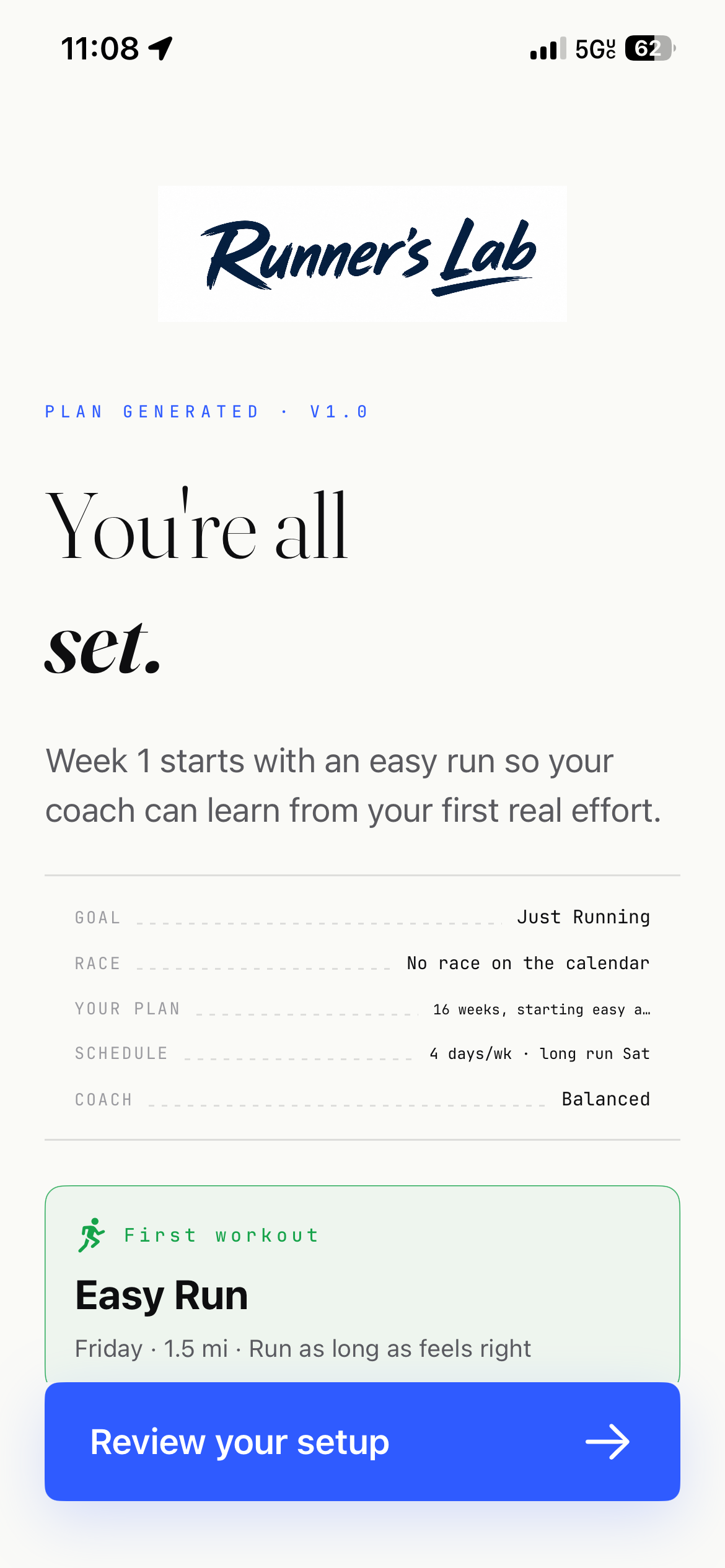
Runner’s Lab HQ is the company. Runner’s Logbook is the first product.
It is built independently by one person who runs, ships software, reads the settings screens other people skip, and is willing to question things that do not make sense. No research department. No advisory board. No lab, despite the name.
We are early.
That means the list of things we want to improve is longer than the list of things we consider finished.
Good. Finished products tend to stop listening.
Where the Journal fits
The Journal is where this company started, and it still holds the practical guidance we would want as runners: injuries, hydration, heat, motivation, and how to keep going when running feels like a chore. It shows where we began. Runner’s Logbook shows where we are going.